
If you read the last thing I wrote about California’s very slow high-speed rail project, you may have noticed that I said walking over to the construction area “requires you to cross an active rail line used by freight trains and Amtrak.” There’s a quite curious detail hiding in that sentence that quite curiously hasn’t been discussed very much.
If you look at the state’s description of the initial project, California is spending at least twenty years, and tens of billions of dollars, to connect the cities of the Central Valley by rail: “High-speed rail construction currently spans 119 miles in the Central Valley across Madera, Fresno, Kings, Tulare, and Kern counties with plans to extend into Merced and Bakersfield.” The current point of the project is to one day allow residents of the Central Valley to take a train from (say for example) Bakersfield to Fresno.
But to get to that very expensive project, I’m going to say this again, you have to “cross an active rail line used by freight trains and Amtrak.” As I was driving around looking at the massively expensive and complicated rail project, this kept happening:
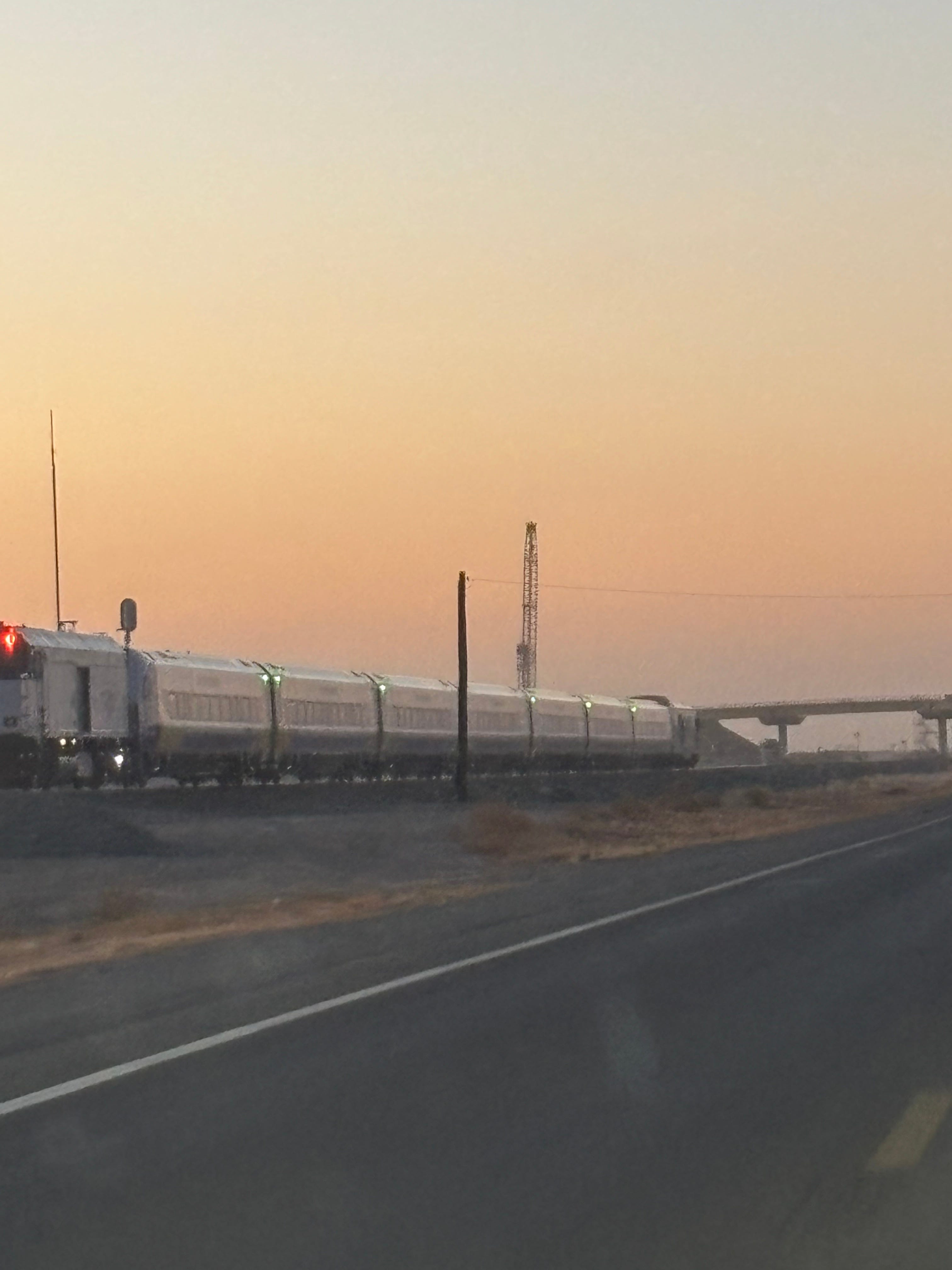
That’s a — well, how can I put this? That’s a passenger train. The Amtrak Gold Runner will currently take you from Bakersfield to Fresno, among a bunch of other Central Valley destinations. This exists right now, providing regular service:
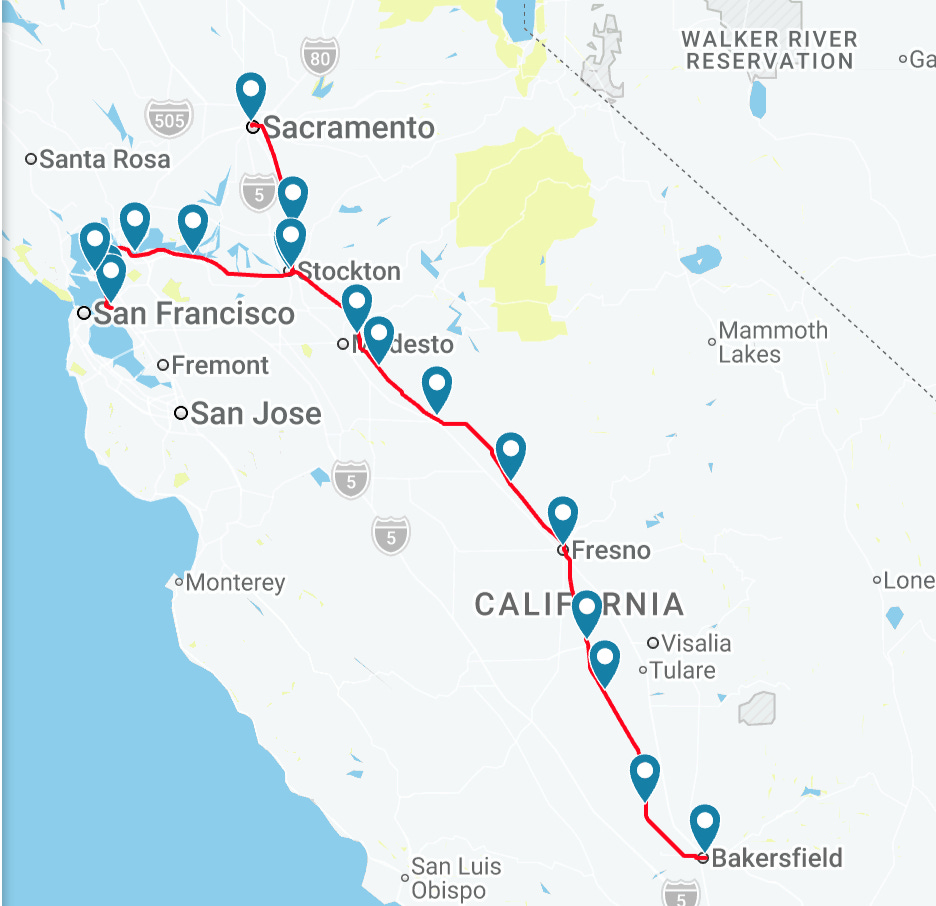
As for speed, it appears to cruise in the mid-80s, but watch for cops and don’t ask me how I know. Nationwide, Amtrak says it “operates more than 300 trains each day — at speeds up to 150 mph,” though those higher speeds are for newer Acela trains in the Northeast corridor. The Acela trains started running on existing track, with some later incremental upgrades, not on a whole new rail system.
The High-Speed Rail Authority is demolishing Central Valley Amtrak stations so it can build new rail that will serve newly constructed train stations, replacing a rail operator that can achieve speeds up to 150 MPH with a train that will one day in a few decades do closer to 200 MPH on a 171-mile route. They’re replacing trains with trains, and train stations with train stations. The Central Valley, which is connected by rail, is being connected by rail, after which the Gold Runner will be shut down where it overlaps, but still operated where it doesn’t.
So where you would now ride one train, e.g. Bakersfield to Sacramento, you’ll instead be able to ride Amtrak to where you get off and get on the bullet train, and then you’ll ride the bullet train, and then you’ll get off where the high-speed rail line ends and get on another Amtrak train. It’s so much more efficient!
When voters authorized a $10 billion bond issue in 2008, they thought they were voting “to develop and construct a high-speed train system that connects San Francisco Transbay Terminal to Los Angeles Union Station and Anaheim, and links the state’s major population centers, including Sacramento, the San Francisco Bay Area, the Central Valley, Los Angeles, the Inland Empire, Orange County, and San Diego.”
Instead they’re getting trains to Fresno where they already have trains to Fresno.
In other news, my last post pointed to a gravel lump at Poplar Avenue, just to the south of Wasco — well short of Bakersfield — and said it was the end of the project in its current form. I have more evidence for that, today, after some entirely courteous and professional people at the California High-Speed Rail Authority sent me their contract for long welded rail pretty much the instant I asked for it:
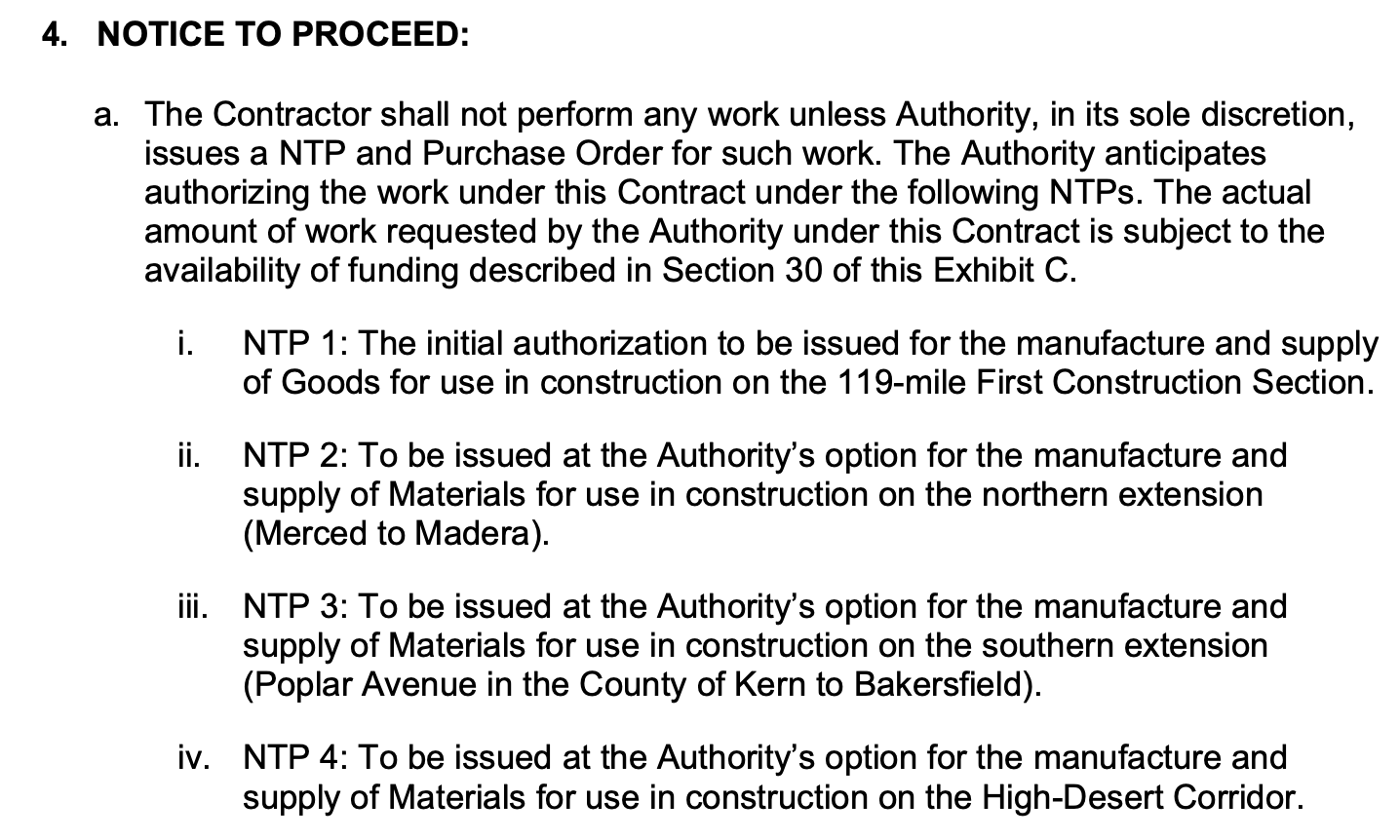
Bakersfield is an extension, not the current project. A future notice to proceed will cover a later extension of the project that will take it as far as Bakersfield, the contract says, past the current end point: Poplar Avenue, site of a certain recently photographed lump. What they’re currently building won’t come anywhere near Bakersfield, the declared southern destination of the initial segment, so the big success that’s coming is that in another five years or so they may have made it to Wasco, population 27,000.
Against the aggressive political rhetoric from the greasy sociopathic governor, the contract for rail also gives us a more realistic sense of how quickly the state thinks it might finish that first 119-mile short segment:
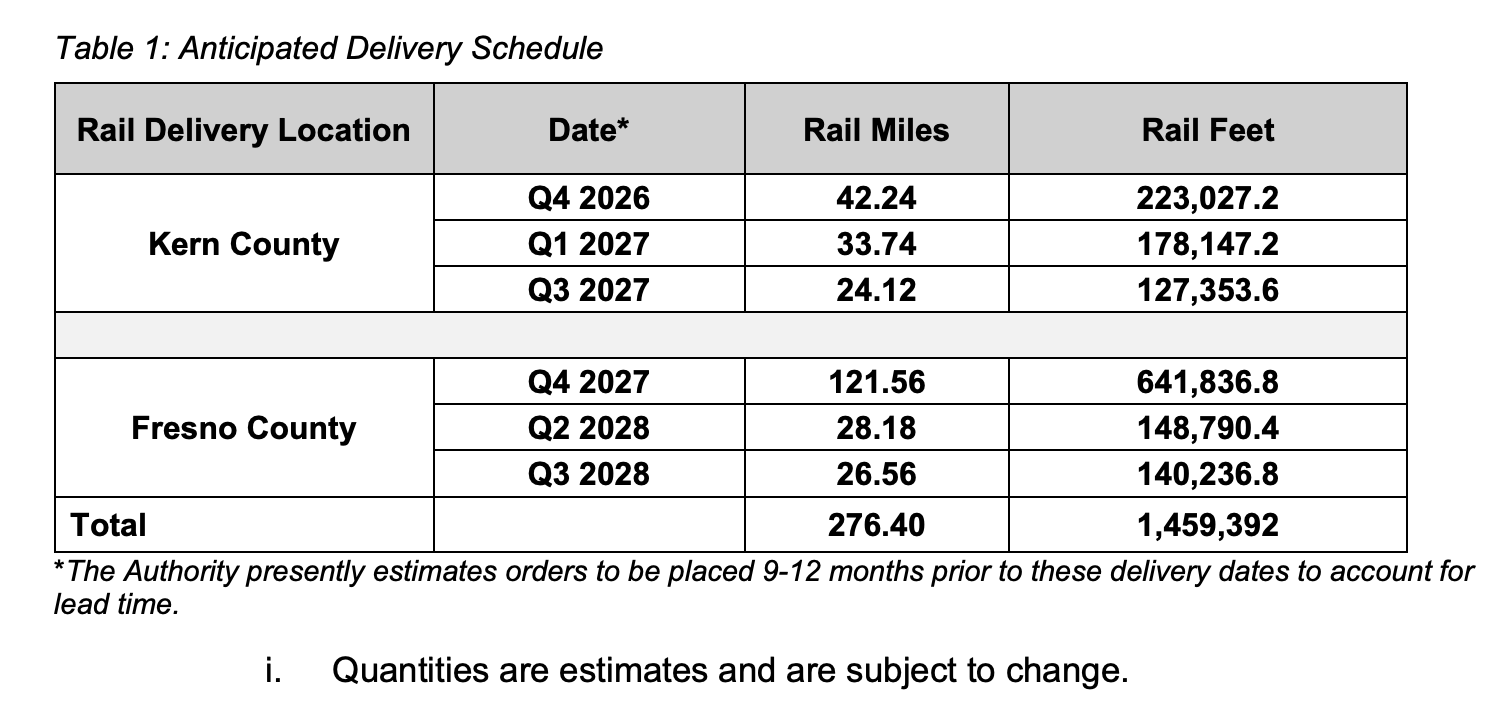
(Total rail miles exceed the length of the current segment because you can’t run a train on one rail, and there are also sections that will be double-tracked.)
So they expect to be laying track for a few years to come, as they get around to the still-unfinished guideway. If anyone with a background in construction logistics and contracting wants to look at the whole contract, here it is as a PDF file, and I invite your thoughts on it:

I have serious doubts about the degree to which the political discussion of the high-speed rail project is going to be able to take on details at this level, so we’re probably going to watch several more years of greasily idiotic SUCK IT, TRUMP! rhetoric on a project that isn’t very successful and isn’t at all efficient or related to its founding promises. But at least the Central Valley will finally have a rail connection OH WAIT.
I state again: this is a very, very successful project. It is funneling and laundering titanic amounts of money into the pockets of a lot of scumbags while wasting very little on actual infrastructure. CA isn't "getting new rail where they already have rail", they're getting fleeced. Everything else is theatre. They want everyone complaining about how long it will take, the cost, the duplication - because that all assumes the objective is to create a great new high speed rail system, as the real objective is being achieved *every day* right in front of us. Until you start seeing "government projects" in this light, you will be a victim.
Morocco has a high speed rail line, the first in Africa, that hits 200 mph.
Morocco’s population is similar to California’s, but Morocco’s GDP is only 182 billion vs. $4 trillion for California. Morocco has a similar GDP to Nebraska.
Morocco’s GDP per capita is $4700 per person vs. $103,000 for California.
Since Morocco seems to do a lot with a little, can someone please ask Newsom if he’s reached out to the Moroccans for help.